FSFT5 – YouTube Musical “Memes”

So people come up to me in the street and ask me, “TempTrack, what do you think of this latest YouTube video?”  To which I usually respond, “huh?”  I’m usually pretty oblivious to many “new” and “cool” things since I am neither cool or hip.  But I do usually find out about things at least a few years after the fact.  For today’s edition of Film Score Friday Top 5 I ask the question of what are some of the best music based internet “memes?”

First, you may ask, “what is a meme?”  Well, according to Wikipedia, it is, “is a unit of cultural ideas, symbols or practices, which can be transmitted from one mind to another through writing, speech, gestures, rituals or other imitable phenomena.”  Specifically an internet meme is one that is spread via the internet, of which the most well-known musical example is Rickrolling (don’t worry, the video is actually part of the great Rocketboom series “Know Your Meme”):

But what are some other examples?  Well, I might have to stretch the definition of “meme” a bit here, but it is all done for a reason, loyal readers.  But let’s start with an oldie but goodie: Yatta!

This video has been floating around the internets since at least 2004, or at least that’s when I first encountered it.  It is a music video for a Japanese band named Green Leaves and the combination of the Garden of Eden costumes, crazy dance move poses, and what might just be the funniest granny ever on the ‘nets (you’ll know it when you see it) make it a hilarious video.  It’s like a funnier version of the Backstreet Boys.  And the mixture of English and Japanese lyrics just sends it to a higher level.

But no meme is truly complete just with just sharing and distribution, a key component is the remix and adaptation.  This is what allows memes to have longevity.  There are tons of remakes of various ilk of Yatta on YouTube, my favorite is a machinima (using a per-rendered video game engine to do animation) version using Star Wars Galaxies.

But some internet trends aren’t born of a singular video or trend, but rather cultural happenings, such as the advent and proliferation of auto-tune.  “Know Your Meme” did a great episode on this, so I’ll let them explain it first. (Bonus, it stars “Weird” Al Yankovic)

But I think this trend reached its apex with the work of the Gregory Brothers and their series “Auto-Tune the News.”  My favorite is their second episode with Katie Couric’s line “very thin ice,” which is so good that it has appeared in many subsequent episodes.

Now, on a very basic level, what the Gregory Brothers are doing is a mash-up, but instead of taking two songs, they are taking regular speeches with new beats and building a new song out of it.  While at the same time they are also doing the same thing to the video, mashing the existing video with themselves and also cutting together certain pieces and doing split screen effects.  It is a very creative and clever commentary on the news.  I just wish they could produce episodes faster.

And speaking of mash-ups, that is the next category.  While obviously not strictly an internet phenomenon, YouTube has certainly allowed for greater distribution and promotion of mash-up songs and videos.  And in a great post-modern meme moment is the mash-up “Never Gonna Give Up Your Teen Spirit.”

But another favorite of mine is “Toxic Love Shack” which is exactly what is sounds like.

Wow, there are a lot of videos in this post, but I have only a few more, I promise.  The next meme trend is that of the “literal video.”  In these videos, a music video is taken and new lyrics are recorded that are a literal interpretation of the video scenes.  Many classic videos have been subjected to this treatment, but none has been as popular as the video of Bonnie Tyler’s classic “Total Eclipse of the Heart.”

Related to the literal video are “phonetic translation” videos in which songs – usually in a foreign language – are subtitled with what the words sound like in English.  Many of these, including the classic “Fart in the Duck” contain some lyrics that are not quite work safe, so I’ll leave that to you on your own time.  In their steed, though , I’ve selected a video with a song that is in English, but you can’t understand the singer so an internet genius has provided subtitles for the hard of understanding.  Ladies and Gentlemen, I give you Mr. Joe Cocker performing “With a Little Help From My Friends.”  Enjoy, and I’ll see you around the webs.

Interval – Or Why I Do What I Do

This past Monday I was really “bummed out,” as we would say when I was young.  A friend of mine posted a link to this article on his Facebook, and I couldn’t actually bring myself to read it all the way through, but also browsing some of the writers other editorials, I began to be depressed and this fed into a dilemma I’ve been wrestling with: how to approach teaching my first class this fall.  But alongside that is my long running anxiety of coming back to grad school for my PhD.  In the face of a terrible job market in higher education, especially for humanities and the arts, I have questioned what it is I’m doing on more than one occasion.  In a world of vast homogenization of the job market, it seems like that it is either business, accounting, computer science, or some other degree that will lead to medical or law school that is the only way to go if you want job security.  So in such a world, why do the arts matter?  That seems to be the attitude of so many students.  On top of the problem of trying to actually prepare students to be thinking members of society and not just working to a goal of a good grade or whatever goal in life (good performance review, bonus, etc) is currently in front of them.

This also dovetails with a conversation I’ve been having with a good friend of mine who I consider a stalwart member of my “Brain Trust.”  In discussing the new Karate Kid movie and by extension the original, she told me about a book she had read (and graciously made some copies and sent to me) that dealt with how we learn, or rather the best way to learn.  You provide the groundwork (in KK the waxing, painting, or in the new, “Jacket on, jacket off, hang up jacket, etc), and the student has the breakthrough when they actually learn how to apply those skills.  Rather then rote learning, you actually have to apply what you have learned, integrate it into everything else you learn.  In what the author calls the “good student syndrome,” the student wants steady progress towards the ultimate goal, whereas in life, it’s really plateaus and breakthroughs.  You have to first learn the basics and then move on.  But conversely, as a teacher, you have to actually provide that foundation.  As a teacher, it’s easy to teach “for the test” – give them the bullet points of facts, dates, etc. that they’ll need to pass the test, and then call it a day – and this is really tempting because it is what so many student expect and want.  But besides making us lazy as a teacher and student, it also makes us intellectually lazy for life.

You see, part of learning, becoming intellectually stimulated for life, is learning how to learn.  How to take in information and process it.  To want not clear-cut answers and facts (trivia…which I love, I’m a massive trivia nerd), but rather systems of thought that can support larger ideas.  To seek out questions and answers that go to the core of who you are and who “we” are.  It is a reflection of this trend that so much popular culture is not made to challenge the audience, and those that do have a hard time finding an audience.  Lost is an exception to this, and it is odd that this show found such a wide audience, though at the same time I feel that it challenged the audience not in a way that made them look inward along with outward, but rather focused on the surface external mystery (though I do couch this in that there was the deeper level of meaning of community and human relationships that was there, but so much of the last half of the show “lost” this thread and it wasn’t really picked up again until almost the end).  It wasn’t challenging like BSG that made us question what it means to be human in the face of the apocalypse (or terrorism).

This is all to say that in approaching my first class, I have decided that I really must try to engage their minds on a deeper level – challenge them, confront them.  In my film class last semester the first set of readings the teacher assigned was from Michel Foucault, and she flat-out said that if you can’t get through this, find it difficult, or that you don’t want to do this kind of reading, that maybe this wasn’t the class for you – and bear in mind that this was a dual listed grad level/upper level undergrad class.  I would like to similarly challenge my students.  To much the same the degree that I am distressed by certain elements of modern culture (American Idol and other such reality television) and I am constantly fascinated by new media trends on the Internet.  And I wholly believe that culturally significant material is being produced and posted on the Internet.

But does the world really care when the people who would study such trends are finding it difficult to secure employment?  In my little niche of the world of film music studies, I find it fascinating that independently produced films made strictly for internet distribution will routinely employ composers to write original music.  Surf around the many Star Trek fan film series sites and you’ll quickly discover that many have composers on their team.  But who cares, really?  What is the point of my field of inquiry in the end?  To say that it’s just about music and media is to be very literal and narrow-minded.  On a higher level it is about how we as humans react to media and storytelling.  How music influences our emotions and thus how we engage and interpret a visual text.  Further, I study modern culture and trends, so part of it is also our cultural history, and what has been a more dominating force in culture of the last 100 years than film, television, and the internet?  As someone once noted, all that has changed is that the screens have gotten smaller.

This may validate my own feelings, but it does little to solve the larger problem, that of the state of education in America.  We’ve spent the better part of the last 30 or more years worried about the bottom line: standardized testing, achievement levels, and no child left behind.  All of which are designed to rate how a school and its students are performing.  We’ve overvalued higher grades and forgotten that ‘C’ means average.  So now it’s all about working the system so that students get a higher grade, and it’s easier and less stressful for a teacher to teach for the test and no more.  Teach from the text.  Well it didn’t work for me, and I feel that most of my major intellectual breakthroughs have happened outside the classroom as I read and challenge myself…well at least until my PhD.  In so many ways, this has been the most intellectually satisfying time of my life.

Of course, I keep throwing around this word “intellectual” which has taken on a bad meaning in America today, but I’ll leave that alone.  This is not a political blog.

I guess my true dream is to rediscover in academia the classical Greek academy, educate the whole person.  So many schools say they do this with their “core classes,” but we all know that many of those are watered down and the students don’t want a hard class “outside their major.”  And maybe this is also part of the problem, this focus on “majors,” that college is a means to an end.  Before, it was you would need a high school diploma to get a decent job and college wasn’t for everyone.  Now, to get that same “decent job” one has to have a bachelors degree, if not a masters.  College is now that means to the middle class dream, and that attitude of “I’m out of here in four years no matter what, so you better not fail me” pervades in the large core classes.  The traditional university has become more about vocational training in so many ways.

And I’m just as guilty of this as the next person, it’s only now that I truly miss having not pushed myself harder in my undergrad.  To have taken those philosophy and English classes and actually earn those minors I thought about.

My dream, my true dream, I guess, is to teach at a school, a small school that does challenge its students.  I don’t care if I have to start it myself, but I wish it to happen.  Start a think tank that is also part of an educational institution.  Have seminars and discussions with students, engage with them.  Who cares if Wagner died in 1883, or that his opera house was built in Bayreuth?  Why did he want that opera house built in the first place, what was its purpose?  What are the themes of Parsifal and what do they say about Wagner’s philosophy?  Indeed, what intellectual philosophies of late 19th century Europe influenced his operas, and how do these philosophers still influence thought today, or do they?  And the whole point of this is not to say, “look at how smart I am,” but rather to pose the question of how have these things influenced me and my modes of thinking?  Revealing the hidden structures of one’s own thought and shaking the scaffolding, see if it holds up.  We need to continually challenge our own thought, question ourselves.  We must do so to grow as a people, or we face a death of civilization, and if I have to turn into Spider Jerusalem to do so, then so be it.

To bring this all to a close, there are certain things in my life that have brought all this to a head recently.  Besides the already mentioned article, I have also been listening to the WNYC/NPR series Radiolab in podcast form.  This show always tries to get behind the story, ask the hard question of why.  And the questions and stories they tackle are ones that usually get to the very core of our human existence.  Now the sheer fact that such a show exists and has some 80 episodes available to download gives me hope.  Not to mention from an aural perspective, its innovative sound design and composition style is nothing short of brilliant.  Further, let us consider Star Trek, and it’s core tenant that humanity’s potential is limitless.  That, as long as we want to, we are capable of so much greatness and good.  While many sci-fi films, etc. project a dim and bleak or sterile future (Blade Runner, 2001, Alien, etc), Gene Roddenberry set out to show us a future, not without its warts, but one in which humanity found a way to come together for the common goal of peaceful exploration.  That our main pursuit in life is not one of wealth or power, but to better ourselves and those around us, be they from different countries or even planets…and to boldly go where no one has gone before.  Not to mention a civilization that still values art and culture, music, poetry…because these things to contribute to our lives.  They enrich us and have the potential to engage us on multiple levels.

And this is why I do what I do, because I believe that music and culture are at the very core of who we are.  That film and film music (and by extension other visual media and their music) are a central piece of how we engage with our modern society, and it is our duty to challenge one another to look beyond because that is how we can grow as a people.  Ask the question of how and why and what a film or piece of music says to us and says about us.  And without teachers in the humanities and arts there to ask these questions, pose them to students, we might end up with a bunch of Bill Lumberghs…and do we really want that?  I didn’t think so.

Good night and have a pleasant tomorrow.

FSFT5 – Musical Moments on TV of the Past 10 Years

It’s been awhile since I did a proper Film Score Friday Top 5, between classes and the difficulty of coming up with a topic each week, I’ve been a bad blogger.  So once again I’ll throw it to you, fair readers, if you have either a topic you want me to tackle or a list yourself, let me know – part of what makes the internets so great is the interactivity of it all.

Anyway, for today’s installment, I have decided to do what I consider the best musical moments on TV (narrative shows, not live concerts, award shows, etc) of the last ten years.  Why ten years, you ask?  Because that is what I know best, and if I try to go further back I do not feel that I’m on as solid of ground.  My criteria for inclusion is memorabililty, re-watchability, and if the music actually served to further the narrative of the show and wasn’t just for cheap plugging or ratings.  I considered both diegetic and non-diegetic music, and the list I came up with actually includes many examples of the blurring of the line between the two.  Lastly, I wanted specific instances, not just so-and-so’s music for x show, and to that end I decided to limit myself to only one instance from either Lost or Battlestar Galactica, though I could have easily done top five lists for either shows and have done so in the past.

Well with all that out of the way, let’s go to the list.  I shall present them in chronological order.

Buffy the Vampire Slayer – “Once More With Feeling” (Season 6, Episode 7; November 6, 2001): Also known as the Buffy musical, this episode, though not the first instance of a “musical episode” within a television show, is certainly one of the most well-known.  Creator/Writer/Producer/Director Joss Whedon also wrote all the song and music for this episode, showing the world that he really is master of all he surveys.  What strikes me most about this episode is how integral it is to the story arc of the entire season, and while one can watch the episode on its own and enjoy the music, without the context of what has come before it, many of the subtleties of the song lyrics are lost – especially in the show’s penultimate number in which the Scooby Gang (look it up) finally confronts the villian…the villian which is actually the cause of the entire town of Sunnydale breaking into song.  And this is what I also find so brilliant, instead of the traditional musical caveat of the characters not commenting on the songs, they are fully aware of their singing and find it quite strange.  This is also the only entry in this list in which it is not a specific moment but rather the episode itself, though musical highlights include Xander and Anya’s  throwback number “I’ll Never Tell.”  Also great are the little moments like “They Got the Mustard Out” or the woman singing to the traffic cop to not give her a ticket heard only in passing as the main characters walk down a street.  It is an amazing episode that set the stage for Whedon & Co.’s Dr. Horrible’s Sing-Along Blog.  And if you haven’t see that…well you really need to.

Life on Mars (BBC Version) – Episode 1 (January 9, 2006): Let me first just say this, if you’ve only seen the American version of this show (from the 2008-09 t.v. season) or if you haven’t seen either, do yourself a favor and get ahold of this show.  They’ve released it on DVD in the US and you might also be able to find it via torrents (that’s how I first saw it prior to its domestic DVD release).  The basic premise of the show is that a modern-day cop is somehow transported back to the 1970s (the how is left open until the end – is he in a coma, did he actually travel through time, is he dead and this is the afterlife?) after being hit by a car.  And it is this sequence, as his is hit by the car and then wakes up in 1973, that I am highlighting here.  As this happens, the David Bowe song “Life on Mars?” off his album Hunky Dory is playing on his iPod in his car, and the song plays through the traveling sequence and continues to play as he wakes up and is now playing on an 8-track.  The song moves into and out of the diegesis and is links the two time periods together and they even used the sound of telephones (heard at the very end of the album track) as the song fades into the police department, and indeed the sound of a ringing phone becomes very important throughout the show.  I am speaking specifically of the BBC version here because this sequence as rendered in the US version does not even hold a candle, and everything that is brilliant about the BBC version is not present in the US remake.  Unfortunatly, this clip cuts off right before the phones come in.  But listen to the song itself and you’ll hear it.

Battlestar Galactica – “Crossroads, Pt. 2” (Season 3, Episode 20; March 25, 2007):  Of course, for all you Galactica fans out there, you know where I’m going here – the use of Dylan’s “All Along the Watchtower” at the end of Season 3.  For a few episodes prior, four characters had been hearing faint snippets of music and eventually towards the end of this season finale, they come together and realize they’ve all been hearing the same song, unbeknownst to them as “Watchtower” (though in a new arrangement by composer Bear McCreary, and the actual melody heard by them is entirely unique to McCreary’s version).  The handling of the sequence musically leading up the four gathering and the subsequent use of the song itself in the new arrangement during the final sequence of the episode is one of the few good examples, in my opinion, of the use of a “pop” song during an ending montage (I’m looking at you Scrubs and The O.C. for gratuitous overuse and bad examples) because it serves purpose other than “setting a tone” in that it truly serves a narrative function.  Note: I am forgoing posting a video of this sequence here in order to save parties that have not seen the show from spoilers.

Chuck – “Chuck vs. the Ring” (Season 2, Episode 22; April 27, 2009):  I’ve written about this sequence, Jeffster’s performance of Styx’s “Mr. Roboto,” in an earlier post, “Domo Arigato, Mr. Bartowski,” so I’ll let you read that instead of recapping it here.  It’s ironic that I put down The O.C. in the previous selection when both it and Chuck were created by the same person, and The O.C. always had a good selection of music, but Chuck, in my opinion, does a much better job of using it.

Lost – “The End” (Season 6, Episode 18; May 23, 2010):   The final musical sequence of Lost is one of the most satisfying musical endings to any television show, I believe.  Where Battlestar has many musically satisfying conclusions, they are separate instances for the most part.  What Michael Giacchino does in the final sequence for “The End” is take at least three major themes from throughout the series and builds them all up into a conclusion (as mentioned earlier, I’m planning a more in-depth analysis later on, once I can transcribe the actual music).  And where some may see at least one, if not more, of the themes as character specific, I see this ending as affirming that many of the major music motifs are not character based, but rather based on themes of the show.  What I find satisfying about it is that it brings to a conclusion these musical themes while underlying many of the similarities between them…the “fundamental interconnectedness” of them, which, in many ways, a major theme of the show…we either live together or die alone. Note: I’m also not linking of video of this sequence either for obvious reasons.

Well, that’s all for now, think I missed any?

Addendum – Full Transcription…Updated

So I had so much fun (no sarcasm) doing transcriptions for yesterday’s post that I went ahead and did a full orchestral version of “There’s No Place Like Home.”  The link below will take you to a .pdf of the score.  Just in case you’re wondering, it’s track 15 on the season 4 soundtrack album. Enjoy.

There’s No Place Like Home – Full Orch

Update!!!  I’ve finished a transcription of “Parting Words” (the raft launch scene). 

Parting Words – Full Orch

I might also tackle the music for the last scene of the series, but I have some other posts planned before I take on that project.

‘Lost’ and Michael Giacchino’s Cell Construction

So you won’t read this until Saturday at the earliest, but this is a pseudo Film Score Friday Top 5 in that it covers five of my favorite Lost moments.  While I might not have talked as much about Michael Giacchino’s magnificent work on the just ended series as, say, Bear McCreary and BSG, my love for it is no less.  Today, I am going to discuss a bit about how Giacchino constructed some of what I consider the show’s best musical moments.  And in a Temp Track first, I’m going to give you musical examples!  It’s going to be legen…wait for it…dary!  Let’s see how this goes.

WARNING —- WARNING —- WARNING!!!!  SPOILERS AHEAD!!!  So if you haven’t seen ANY of Lost, then you might not want to read any further.

Okay, still with me?  Great.  So I’ve mentioned in some earlier posts that Giacchino constructs many of his cues from small musical cells, starting with a very sparse texture (many times just piano and maybe a cello) and building up from there.  He’ll repeat the same material, adding countermelodies and other things, but the core harmonic and melodic cell remains.  The first one I want to talk about is one of the most heard themes in the entire show, simply titled “Life and Death.”  As many of you might know, even if you’re not fans of the show, Lost was by no means shy about killing main characters, or even secondary, hell even minor characters.  Let’s face it, people dropped like flies on that wacky island.

In the twentieth episode of the first season, we had the first major death, Boone.  But what was so great about it was that it was paired with the birth of Claire’s baby, Aaron.  Hence life AND death.  The cue proper that I’m discussing begins about forty seconds into this clip.

As you can hear, he starts with the bare harmonic outline then bringing in the actual melody and slowly building in some strings.  Though unlike most of the cues I’ll discuss later, it never truly builds into an overpowering force.  Hey, someone’s died here, we can’t get too optimistic, right?  Anyway, the basic theme is like so (Note: I don’t have the best ear for transcribing music, so please forgive any in my transcriptions):

The first chord of the last bar does change occasionally, so I’ve gone with what is heard in the first full statement.  As I said, this theme is reused many times whenever a major character dies.  One of the most heartbreaking of all deaths on the show was the end of season three when Charlie dies, and without fail, the theme is brought back out, but with a new (counter)melody.

 But let’s move to something a bit more uplifting.  Other than the death of Charlie, just shown, one of the most refered to moments of the show is the end of the episode “Walkabout” (season 1, episode 4), and I must admit that this was the scene that got me hooked.  I had never heard such music for a television show (I had yet to watch BSG), and I knew I had to go out and buy the season 1 DVDs.  It really is a simple two-part, four measure phrase with a slowly ascending melody and an eighth-note ostinato.  In this clip you’ll hear it slowly build up (the dialogue buries the beginning of the cue) as we see Locke slowly realize that he has feeling again in his legs and stands for the first time in years.  It was a powerful moment, especially because before this episode we had no idea that Locke had been in a wheelchair prior to the crash.

The basic part is as follows (this one was a hard one to crack, especially because I was having to work straight from the video as this cue specific was not on the soundtrack album):

Again, what standout in my mind is how Giacchino builds something so powerful out of such simplicity.  As I said, tiny cells of music built up, and, of course, the addition to the trombones just drives the whole cue home.

The penultimate episode of season 1 provides a great moment in the pantheon of Lost, the launching of a raft that the castaways hope can find help to get them home.  It is a another moment, like all the ones discussed today, in which the producers gave the sequence over to Giacchino’s music, trusting him to take the visual and send it into a mythic realm with his scoring.  And without fail, he succeeded.  This cue, “Parting Words,” is made up of three small cells that are mixed and matched:

They all have the same harmonic foundation of alternating Db major and G minor chords and are arranged as A-B-A-A-B-A-A-AC-AC-AB-AC-AB-AC-AB (where the letters are together, it indicates the cells being played at the same time).  In the scene below, also notice how in the first five iterations that there is a measure of pause inserted lengthening each cell to eight measures.

And like all these themes, they appear again and again.  When, in season 2, the people who were on the raft finally make it back to the beach, we hear this theme once again with a few new twists.

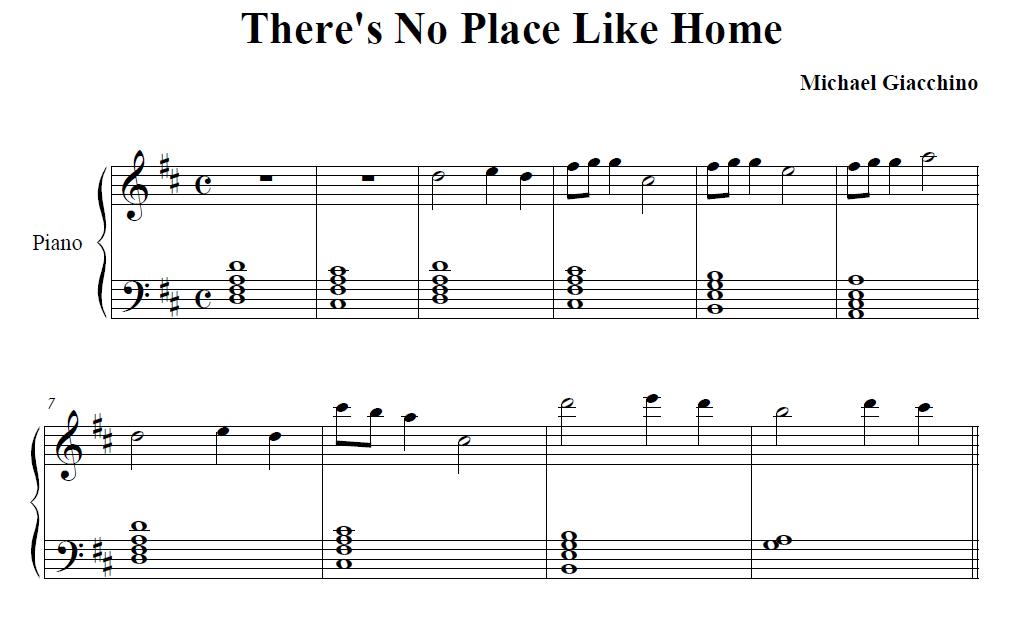
The last cue I want to consider is one of my favorite from the series, and also one of the last major themes to be introduced.  It is the first music we hear as the erstwhile Oceanic 6, who have escaped the island, land in Hawaii in the second to last episode of season four.  The cue is called “There is No Place Like Home,” and features a theme that became more important as the show progressed towards its final episode and was then heard many times in the finale.  In this transcription, I have also included the full theme with countermelody(Note: the first two chords are cut off in the below clip):

As you can hear, it is constructed just as the previous cues, starting with a simple piano version before adding strings and a countermelody to the proceedings, and then fading back away.  In many ways, this cue is related to the earlier “Life and Death,” especially in that instead of continually building, such as with Locke’s cue or “Parting Words,” it fades back out.  Also note how the first two chords for both “Home” and “Life and Death,” arguably the heart of the both cues, are related by a third – DM to F#m and BbM to Dm respectively.  Further, you may notice that the countermelody is a sequenced and altered version of the eighth-note ostinato heard in the above Locke theme.  In fact, many of these themes do bear a resemblance, if not explicitly musical, at least “spiritually.”  This is all brought home in the final scene of the series in which “There’s No Place Like Home,” “Life and Death,” and “Parting Words” all make an appearance.  I’ll forgo posting a clip of that just in case.  While the above clips are indeed spoilers, they would not really ruin ones enjoyment, the last scene of the series, on the other hand, would be a bit to much for a Lost virgin.

I hope that this modest post has provided a glimpse into how Michael Giacchino constructed some of the best musical cues of the series, and indeed, for any television show ever aired.

Update 6/13: I’ve gone back and fixed a few things in the voicings in the “Parting Words” transcription. 

Music for the films of Christopher Nolan

Happy June, fellow travellers.  Here atop Temp Track Plaza in the American West the mercury has been steadily rising and once again makes me long for the days when I could afford that greatest of all sins: central air.  Alas, the life of a PhD student does not pay for such luxuries.  But one of the few pleasures I can afford is that of film, and we are now knee-deep into the Summer 2010 film season.  The next film I’m really excited about this summer doesn’t come out until July though, and you readers have probably already figured out what film I’m talking out.  Yes, it’s the seventh film from director Christopher Nolan: Inception.  If you have somehow managed to miss the trailers and such for the film, check them out here at the film’s website.

What I wish to discuss here is a bit about the films of Nolan and the music that accompanies them.  In the little over a decade of Nolan’s professional career, he has made 6 films using basically two composers (technically three, but since Hans Zimmer and James Newton Howard worked on the same films, I’m counting them as one).  Wrapped up with this whole discussion is Nolan’s shift from composer David Julyan, with whom he worked with on 4 of his 6 films, to Hans Zimmer and Remote Control Productions (where James Newton Howard sometimes  works it appears) for the Batman films and the upcoming Inception (which lists only Zimmer on the credits).  I know many people in the film music community have varying and strong opinions about Zimmer and Remote Control, almost as divisive as opinions on James Horner, but rather than letting this sink to the level of modern political discourse, I would ask that we strive to keep a civil tone.

But before I tread into that minefield, lets first discuss Nolan and his films.  His filmography is as follows: Following (1998), Memento (2000), Insomnia (2002), Batman Begins (2005), The Prestige (2006), The Dark Knight (2008), and the forthcoming Inception (2010).  Setting aside music for a moment, there is a remarkable consistency in quality and style among these films.  Beginning with Memento, Nolan has always worked with cinematographer Wally Pfister (nominated for an Oscar for each of the last three released films), and with the exception of Insomnia, Nolan himself has always had a hand in writing the scripts (many times along with brother Jonathan Nolan).  Further, all of his films were produced by his wife Emma Thomas.  What is also very evident watching the films is a very consistent visual style starting with Insomnia of long shots and aerial photography that began with his working with a large enough budget to afford such things.  Along with this is what I can best describe as a coldness, an emotional distance between camera and subject.  And it is into this distance the music falls.

David Julyan first teamed up with Nolan prior to Following for some of Nolan’s short films made during and after college in London.  His style is largely ambient type tracks using a mixture of electronics and strings (either synth or live), and sometimes other orchestral sounds.  In many ways, the early film scores remind me of Mike Post-esque Law and Order score – dark and moody.  But I would make a similar argument about Julyan that I do about Nolan, that everything took a leap forward with Insomnia.  For Nolan, he retained much of his trademark storytelling techniques – non-linear, puzzle like flashes or flashbacks that keep a viewer disoriented and guessing – but adding many more to the arsenal that come with a larger budget and studio backing.  Similar with Julyan, with more money at his disposal not only did his use of electronics and live instruments become greater, but his compositional technique flourished with said greater freedom. Whereas Following and Memento featured very sparse scoring (like I said earlier, akin to an episode of Law and Order), with Insomnia Julyan wrote longer cues that attempted to fill in the distance between camera and subject with the psychological tension that the film demanded of every sunlinght-drenched neo-noir shot.  The film’s tone is as dark as the music, but since the film is set in northern Alaska where during some seasons the sun never sets, the film itself is in perpetual daylight (a key device in both Nolan’s 2002 film and the 1997 Norwegian film on which it is based).  The juxtaposition of the two is part what makes the film unsettling to a viewer.

Skipping over Batman Begins for just a moment, let’s consider Julyan fourth and so far last collaboration with Nolan, The Prestige.  Many have found this a hard score to get at because it sort of recedes into the background of the film for much of the time.  It lacks any of the activity found at times in Insomnia and is very much the “musical wallpaper” that so many deride film music to be.  Listening to the score on its own illuminates that most of the time the score is long, held chords with movement occasionally happening.  Sparse, stark, and dark.  Just like Insomnia.  Part of this I do attribute to Julyan, but I also think that it is also, partially, what Nolan wants.  The music very much fits the aesthetic distance between camera and subject that I so noted earlier.  And if you had asked me a few years ago what I thought about this score, I might have said that it worked in the film, but when divorced from the visual, it doesn’t hold up.  This feeling is still true to some extent, but in the intervening years, I have developed a greater appreciation for this ambient type of scoring that at times blurs the line between music and sound design.

Take the cue “The Transported Man” for instance, which just popped up in my iTunes (YouTube version here).  The cue begins with what sounds like an orchestra tuning in, but the clusters soon coalesce then fade away into a slow-moving cue that has a low percussive throb mixed with sustained strings and other sounds mixed it.  It’s incredibly dense music that only sounds simple on the surface.  Yes, the music may disappear for a viewer of the film, just like a slight-of-hand magic trick, but could almost be more of a case of, to paraphrase The Usual Suspects, “the greatest trick [Julyan] ever pulled was convincing the world [his music doesn’t] exist.”  If there is a ill-word to be uttered here, it is that, at times, the scores for Insomnia and The Prestige sound too much alike.

So now let us turn to Nolan’s big-budget blockbusters, Batman Begins and The Dark Knight (which will hopefully be followed in 2012 by Nolan’s third and final Batman film).  As mentioned above, these scores are done with Hans Zimmer and his Remote Control Productions (aka Team Zimmer, a phrase coined by a good friend of mine), and as mentioned elsewhere on this blog, are billed as a collaboration between Zimmer and sometimes Controlee James Newton Howard (from what I can find on the interwebs using the Google, the exact roster of composers at Remote Control is hard to pin down).  In many ways, it is obvious that the static, more ambient music of Julyan would not be a good fit for a summer action film such as that the Batman films would be, but at the same time, Zimmer/Howard composed a score that at times shares characteristics with Julyan previous work for Nolan.

Examine the opening cue on the Batman Begins score album, ‘Vespertilio.’  It begins with some ambient like effects that are meant to mimic the sound of a large bat flapping his wings and then moves into what we can identify as the Batman theme: the active string motor underneath with large brass chords sweeping up and down slowly.  If we were to take out the active motor, it would not be unlike something Julyan might write (we might also have the turn down the volume on the brass, but the principal remains).  Both Zimmer/Howard and Julyan’s scoring are athematic in a traditional sense, their scores are less melodically based and more harmonic, but if one listens closely and enough times, melodic themes to begin to emerge, such as Batman and the Joker, a love theme, etc.  This is all to say that despite the change in composers, there are aesthetic continuities between the films, and the differences can be ascribed to, rather than a change in composer, the differences between an intimate psychological neo-noir film like Memento or The Prestige and a summer action (albeit also psychological and noir-ish) film like the Batman films.  Throughout his films, Nolan has a certain type of music that he feels fits his visual language well.

Could Julyan have scored the Batman films effectively?  Maybe, but judging from his work on The Descent, I think that Zimmer/Howard were a much better fit for a more complex scoring project.  But what I’m arguing here remains, that Nolan has a certain sound for his films that he wants that fits with what he and Wally Pfister are creating on-screen.  Think of the opening sequence of The Dark Knight.  The long helicopter shots of Gotham City (really Chicago), shot in such a way to really be any city.  There is a certain feeling to these shots, that distance I’m talking about (accentuated here by the masks worn), and the music starts very soft, in many ways silent, and it takes almost 6 minutes to build up to the moment when the Joker takes off his mask and we have the descending chord that accents the gesture.  It is a great musico-visual moment and is a reason why I love using the scene in a class context.

This is all to say that while I feel that ‘auter’ theory in film studies is a tricky thing to deal with for students of film music (a future blog post), the continuity between certain elements of the scores for the films of Christopher Nolan show that he has a certain sound in mind for his films that was cultivated through his work with Julyan and has transferred into his current collaboration with Zimmer and Co.  There is also a close working relationships between Nolan and his composers, evident when you watch some bonus materials on the DVD discs in which Zimmer says, in the case of The Dark Knight, he gave Nolan a large sound file full of noise and sounds to help in Nolan deciding what kind of music and feeling he wanted for the Joker.  My wish is that all directors were as aurally aware.